
Article: What Is a Spell? How Does It Work?
What Is a Spell? How Does It Work?
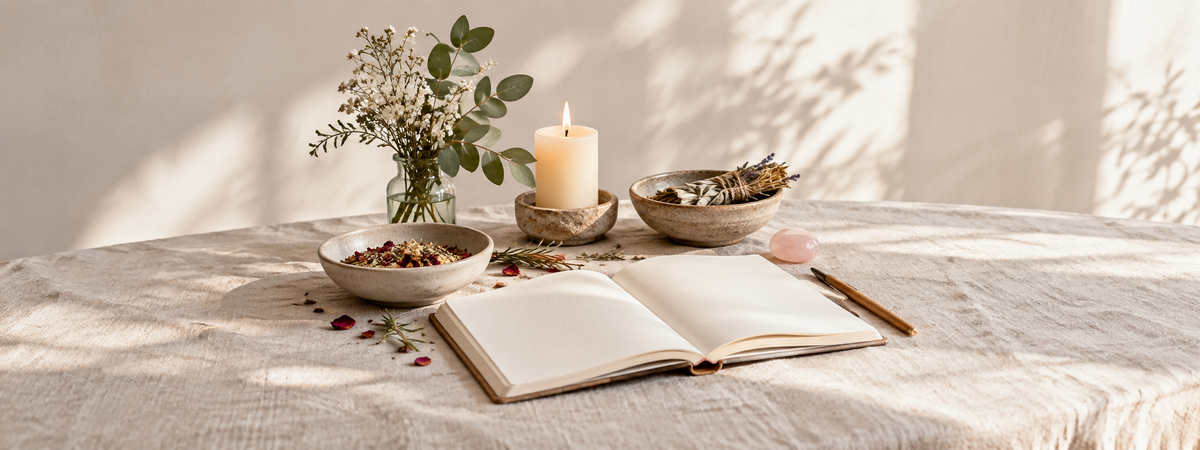
There is something special about giving an ordinary moment a little meaning. A crystal beside your journal. A few words spoken with purpose. A small ritual that marks the beginning of something you want to welcome into your life.
Spellwork can begin here, with a clear intention and a thoughtful action. You do not need an elaborate altar or a cupboard full of ingredients to make the moment personal.
What is a spell?
A spell is a deliberate ritual through which someone expresses an intention for change. It might involve spoken words, a written wish, a meaningful object, visualisation or a sequence of simple actions.
The intention gives the spell its direction. The ritual gives that intention a form you can see, hold or repeat.
For example, someone beginning a creative project might place a crystal beside their notebook, speak a few words about courage, and then write their first page. The object becomes a symbol of their commitment, while the writing gives that commitment a practical expression.
People understand spellwork in different ways. For some, it is a spiritual practice. For others, it is a meaningful way to pause, reflect and act with purpose.
How does a spell work?
One useful way to explore spellwork is through four connected aspects: conscious intention, personal symbolism, the experience of energy, and spiritual meaning. These offer ways to understand a ritual, rather than proof that it can control events.
1. Conscious intention: choosing your direction
This is the part you deliberately plan. What are you asking for? Why does it matter? What are you prepared to do?
“I welcome more kindness into my day” gives you a clearer direction than “I want everything to change.” You can then choose an action that belongs with it: speaking more gently to yourself, checking in on someone, or making time for a conversation.
Preparing and performing the ritual can become a personal commitment. Give that commitment somewhere to go once the ritual ends.
2. Personal symbolism: what the details mean to you
Colours, scents, words and objects can carry memories and associations. Pink might remind you of tenderness. A favourite stone might represent a fresh start. A handwritten note might make an intention feel more personal.
In spellcraft, this is often described as the unconscious aspect: the feelings and associations beneath the words you consciously choose.
Your own response matters. If an ingredient means something different to you from its traditional association, consider whether it belongs in your ritual. A simple object with a clear personal meaning can be a thoughtful choice.
3. Energy: the attention you bring
Many spiritual traditions describe spells as a way of gathering and directing energy. Some understand this through a belief in connections between people, nature and the wider universe.
Within a ritual, practitioners may use breath, repeated words, visualisation or movement to express that idea. These are spiritual interpretations; they do not establish that a crystal or ritual emits a force that changes external events.
You can approach this aspect gently. Be present with your chosen intention, and let your words and actions express it. You do not have to produce a dramatic sensation.
4. Spiritual meaning: connecting with what matters
A spell may include a connection with the Divine, a deity, ancestors, nature or a person’s own sense of purpose. Different paths use different language.
Choose a connection that feels familiar and respectful. You do not need to invoke an unfamiliar spiritual figure to make your ritual complete.
This aspect asks a quieter question: how does the intention fit the person you want to be and the values you want to live by?
Is a spell the same as a prayer?
There can be overlap. Prayer often expresses gratitude, asks for guidance or addresses a higher power. Spellwork commonly gives an intention a physical form through an object, written words or ritual action.
Some people combine the two. Others practise without calling on a deity. The distinction depends on the tradition and the individual.
Choosing crystals for your spell
Crystals can serve as beautiful symbols and reminders. Choose one for the meaning you give it, its appearance, or the way it fits your ritual. They are optional, and no particular stone guarantees an outcome.
Rose Quartz is traditionally associated with love, kindness and compassion. It suits a ritual about treating yourself gently or appreciating your connections. Our Rose Quartz meaning and care guide offers more about its symbolism and practical care.
Citrine is commonly associated with optimism, creativity and abundance. You might choose it to symbolise beginning a project or taking a purposeful next step. The linked raw pieces are heated citrine; check the listing for their individual details.
A simple spell for a kind and purposeful beginning
This gentle ritual brings the four aspects together. It uses no flame, smoke or water, and can be done with an object you already own.
You will need:
- A piece of Rose Quartz, Citrine, or another meaningful object
- A small piece of paper and a pen
- A few quiet minutes
1. Choose your intention. Write: “Today, I move forward with kindness and purpose.” Make the wording your own if another intention feels more useful.
2. Name one action. Underneath, write something small you can actually do: begin a page, organise a workspace, send a thoughtful message, or make time for a conversation.
3. Give the intention a symbol. Place your crystal or chosen object beside the paper. Let it represent kindness, a fresh beginning, or the meaning you have chosen.
4. Speak your spell. Hold the object comfortably, or leave it resting on the table. Take a few unhurried breaths and say:
With kindness in my words,
and purpose in my day,
I honour this beginning
through the steps I take.
5. Picture the action. Imagine yourself carrying out the small task you wrote down. If spiritual connection is part of your practice, take a moment to acknowledge it in your own words.
6. Close and begin. Thank yourself for making the time. Leave the paper somewhere useful, and take your chosen step when you can.
The intention is your conscious choice. The object carries personal symbolism. Your attention expresses the energetic aspect as you understand it. The values or spiritual connection give the ritual its meaning.
What if nothing seems to happen?
A spell does not promise a result, and an unwanted outcome does not mean you failed to believe strongly enough.
You can revisit the intention, notice what was within your control, and decide what practical step comes next. Leave room for other people’s choices and for circumstances a ritual cannot determine.
At Dante’s Luxury, we love rituals that make room for meaning in everyday life. A few thoughtful words, a beautiful stone and a small action can be enough to mark a beginning that feels like yours.

